Cookie consent management
Montessori Metal Fraction Circles
zoom_in
  • Montessori Metal Fraction Circles
  • Montessori Metal Fraction Circles
keyboard_arrow_left keyboard_arrow_right

Montessori Metal Fraction Circles


Montessori Metal Fractions: A Sensory Understanding of Fractions

This Montessori material is designed to offer a sensory and concrete experience for learning fractions. By handling the metal pieces, the child develops an intuitive and lasting understanding of this essential mathematical concept.

Description of the Material:

  • Main Objective: Sensory understanding and handling of fractions.

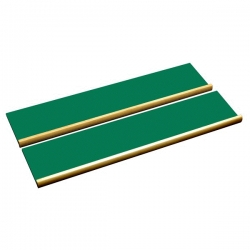
Delivered without the wooden stands: (see reference L013-1).


check In stock
€89.99
Tax included

+

PRESENTATION OF THE MATERIAL:

Delivered without the wooden stands:

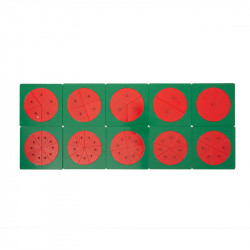
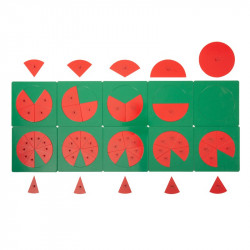
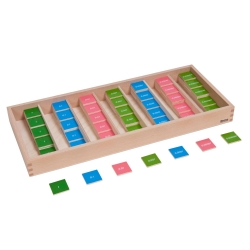
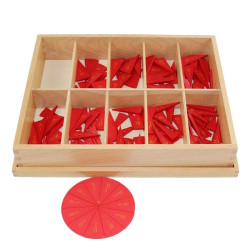
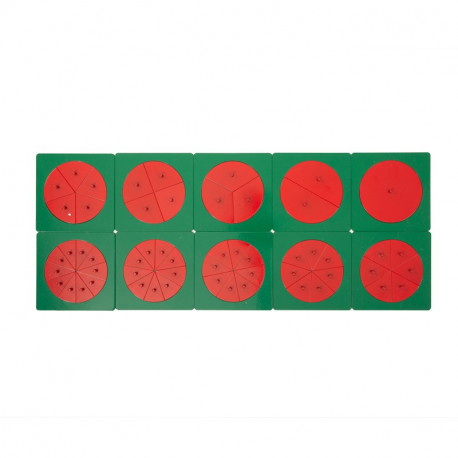
  • Divided circles, 10 in total: first there is a whole circle, then a circle divided into two, a circle divided into three, a circle divided into four and then into five, this for the first stand. On the second stand there is a circle divided into six, a circle divided into seven, a circle divided into eight, a circle divided into nine and the last one divided into ten.
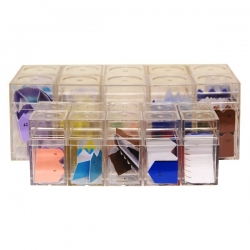
  • along with this material, a tray with a small dish containing a decimal system bead, small cut paper pieces and red cardstock discs, a pair of scissors and a black pencil.
  • a mat

PRESENTATION:

  1. go and fetch all the material with the child
  2. settle on the mat with him
  3. tell him the name of the activity: "This is the fractions material. Have you already heard of fractions? Take the decimal system bead, show it to him and ask, do you know what this is, it's 1! Do you think we can divide 1, one unit? Do you remember what dividing is: it's sharing into equal parts. If I take a hammer and strike the bead, what will it do? There will be pieces, yes, but will they be pieces divided into equal parts? No. But if I take an apple and share it in two, I'll have two apple halves, two half-apples, and if I have four children, I'll cut each half in two, I'll get four pieces of apple, a quarter of an apple. Do you know any other things that we can share? When I have a liter of milk and I share it, what do I have? Half a liter.
  4. take the red cardstock disc and tell the child: "You see, if I press very hard on the bead I'll get a disc, and if I cut the disc this way (cut it into two unequal pieces), is that a fraction? No, it's not shared into equal parts. A fraction is the sharing of a unit into equal parts. And here, look (take out the first iron fraction disc), this is 1. Take out one half of the disc divided in two and tell the child: "You have a name, a first name and a surname, a family name; well, each disc is going to have a family name too. You see, this one is going to be the family of halves. Take a small piece of paper and write a two under a line. Then take out a third and say: "Here, you see, this is the family of thirds." Write a three under a line and place the paper near the third you took out. Take out a quarter and do the same, as well as with the fifth. "So, you see everything we wrote, that is called the denominator. It's the family name. And now we're going to look at the first names of all the fractions. Show the two and say: "this is the family of halves, we have one half." Write the 1 above the two. Show the three and say: "this is the family of thirds, it will be called one third" and write 1 above the three. Take out the second third and tell the child "And what will this one be called? Two thirds." Move on to the family of quarters and do the same.
  5. tell the child that what corresponds to the first name is called the numerator and that what corresponds to the family name is called the denominator.
  6. do a three-period lesson: ask the child to show a denominator and a numerator, then point to a numerator and then a denominator and ask him what it is.

Educational Benefits:
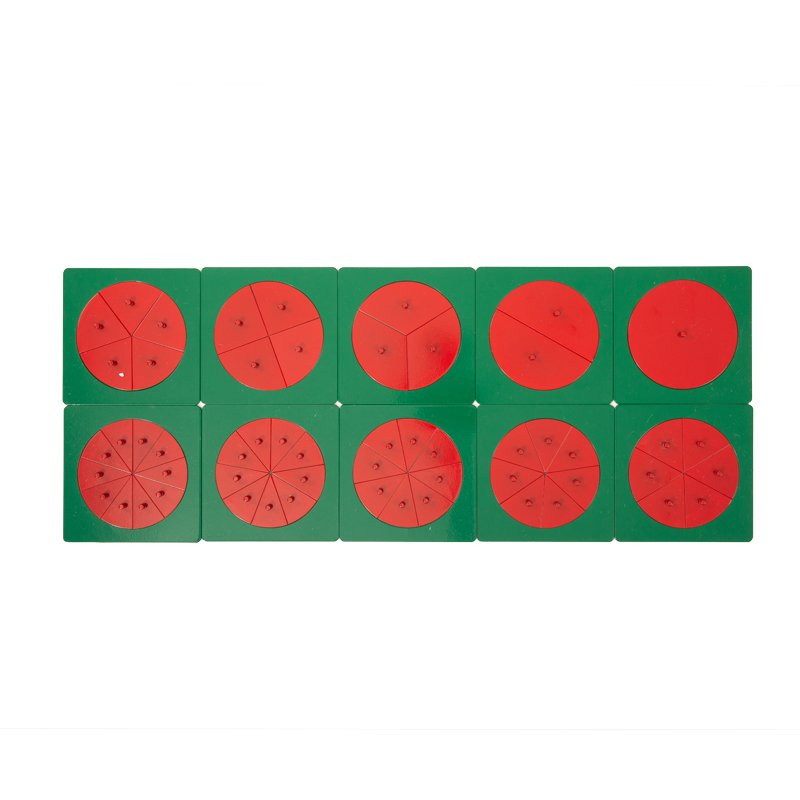
  • Concrete Understanding of Fractions: The child visualizes and handles fractions, which makes understanding the abstract concept easier.
  • Developing Logical and Mathematical Thinking: The child learns to compare, order and combine fractions.
  • Improving Fine Motor Coordination: Handling the metal pieces stimulates fine motor skills.
  • Preparation for Operations on Fractions: The child acquires a solid foundation for learning the addition, subtraction, multiplication and division of fractions.
  • Strengthening Concentration: The activity requires concentration and precision.

D522/L013 - 9501886226412

Specific References

UPC
200000000905
EAN13
9501886226412

Products accessories

Customers who bought this product also bought:

16 other products in the same category:

Comments (0)
No customer reviews for the moment.