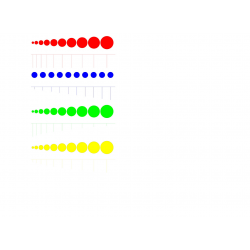
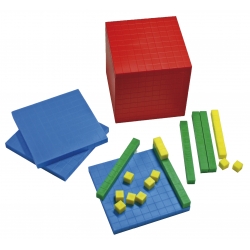
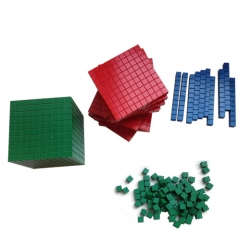
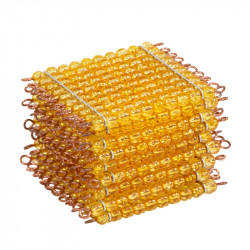
a blue bar one thousand times larger than the previous ten, representing 10,000.
a red square one thousand times larger than the previous square, representing 100,000.
1 large green cube one thousand times larger than the previous cube, representing 1,000,000.
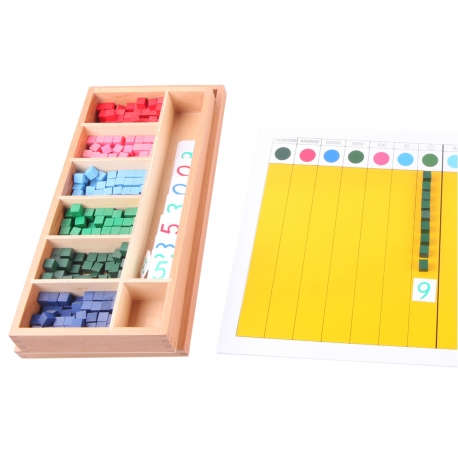
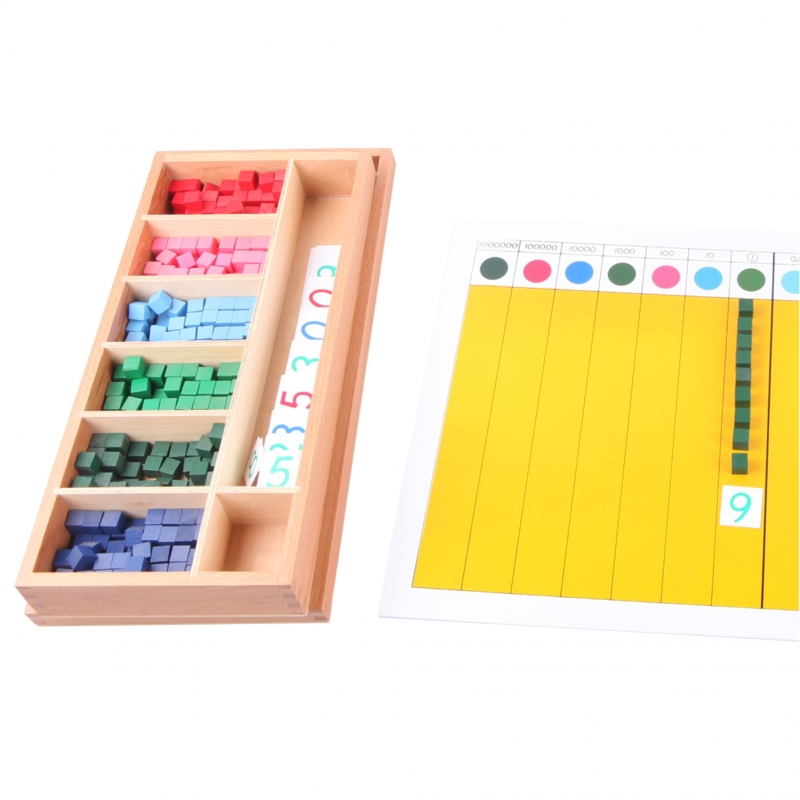
a mat.
PRESENTATION:
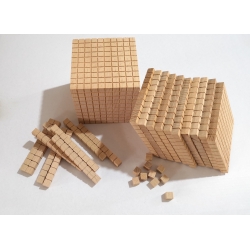
invite the child. Fetch a mat and lay it out, then go and get the small green cube, the blue bar, the red square and the thousand cube.
show the child the small cube and ask what it is: it is a unit. Show the blue bar and ask what it is: a ten. Ask the child to count the segments on the bar. Show the red square and ask what it is: a hundred. If needed, lay the blue bar along each side of the red square while counting: 1, 2, 3, 4, 5, 6, 7, 8, 9, 10. Ten tens equal one hundred. Then take the largest green cube and ask what it is: 1000.
repeat with the child, pointing to each object: 1, 10, 100 and 1000.
ask the child to close their eyes and to open them only when told. Fetch the 10,000 bar, the 100,000 square and place them on the mat. Then bring the large 1,000,000 cube and at that moment ask the child to open their eyes. Tell them you are going to see what has been brought. Show the 10,000 bar, telling them what it is, and do the same for 100,000 and 1,000,000.
give a three-period lesson: ask the child to show 100,000, 10, 100, 10,000, 1, 1000, 1,000,000, then point to an object and ask: "what is this?"
at another time, introduce the symbols. Begin with the ones already known: 1, 10, 100 and 1000. Then introduce 10,000, 100,000 and 1,000,000. Work on these three figures only, mixing them in turn and asking the child to show where 100,000 is, where 10,000 is, where 1,000,000 is. Then move to the final stage of the three-period lesson (what is this?). If the child seems comfortable, ask them to match each ticket to its corresponding object.