keyboard_arrow_left
keyboard_arrow_right

CONTENTS:
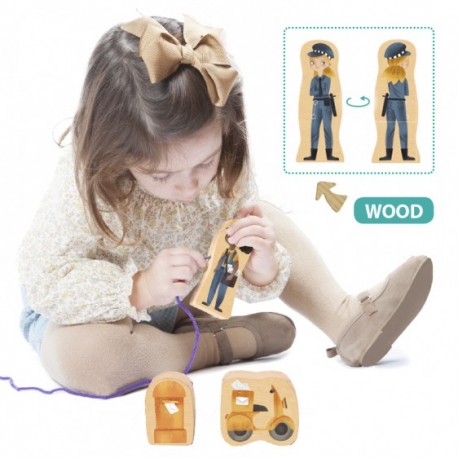
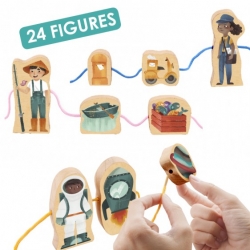
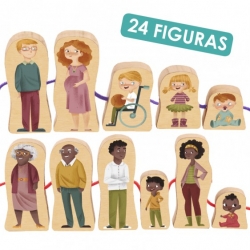
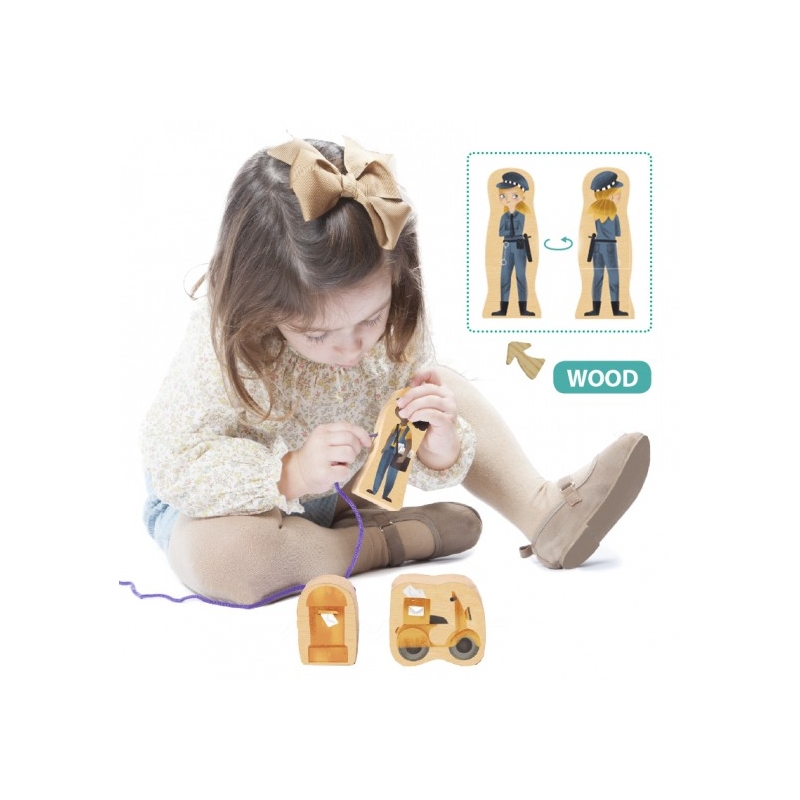
The set is made up of 24 thick, high-quality double-sided printed figures representing different occupations and their associated items.
CONTENTS:
The set is made up of 24 thick, high-quality double-sided printed figures representing different occupations and their associated items.
ABOUT THE GAME:
- 8 wooden characters representing different professions.
- 16 items including the means of transport and the objects or tools related to each profession (two items per profession).
- The figures are reversible and printed on both sides.
- They stand upright, allowing the child to play with the characters.
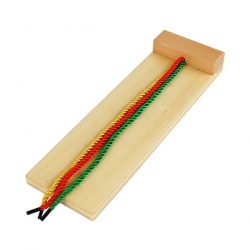
- Includes 8 cords in different colours so the child can link the figures together.
RECOMMENDED AGE AND NOTES:
From 2 to 6 years.
The thickness of the figures makes them easy for younger children to pick up and handle. Their great stability lets the child play with the characters. Although the game is intended for children aged 2 to 6, it can also be used with older children with special needs who need to work on fine motor skills, hand-eye coordination and manual dexterity in general.
Inspired by the Montessori method.
LEARNING OBJECTIVES:
o Develop fine motor skills and manual dexterity.
o Encourage symbolic play.
o Explore the theme of diversity within the family.
o Develop and enrich basic vocabulary related to occupations and their associated objects.
HOW TO PLAY AND ACTIVITIES:
1. Ask the child to choose some characters.
2. Then ask them to identify each character's profession and to pick, from all the items, the two they think match that profession. If the child is very young, we can guide and steer the activity.
3. Choose a cord for each profession and link together the character and the items of the same profession. Do the same with all the occupations.
Suggested activities:
1. Who is who? With this activity we work on recognising professions. First, ask the child to identify each of the professions. If they are young, we can guide them with questions: who is the police officer? Where is the firefighter? And the teacher? Once the child has recognised each profession, ask them about related actions: who catches the fish? Who delivers the letters to the mailbox? Who puts out the fire? and so on.
2. What is it for... Place all the figures on the table and ask the child to point to the figure the adult describes: "Show me the vehicle used by firefighters" or "Show me the objects that make up the police officer's uniform", "What is the case carried by the doctor for?"... Alongside the identification work, the child will describe each of the items.
3. Sorting. Ask the child to sort the figures by type: whether they are characters, means of transport or objects. Once the child has grouped the figures, you can play around these three categories, analysing the differences between the items in each group. For example, in the professions group we can talk about the diversity of genders and backgrounds of the characters, look at the differences between the various uniforms or identify each professional's role in society. In the transport group, we can analyse the vehicles one by one, naming them, describing them and linking them to a profession. We can also identify which are faster, where they are used and why they suit that profession. As for the objects, we can examine with the child what they are, what they are for and how they are used.
4. What would happen if... We can work with children's imagination and creativity by combining different items and professions. For example, we can ask: "What happens if we give the firefighter a boat?", "And a planet to the farmer?", "And a bicycle to the fisherman?" A very playful activity.
5. The fastest: Several children can play this game. All the figures are placed on the table. The adult gives clues about a character. To grab the matching figure, children must stay alert and be quick to get the right character. You can ask them "I need you to choose the items the farmer uses." The children must identify them quickly. Or "Find the means of transport with a siren." If a child picks up the wrong figure, explain to them where they went wrong.
CONTENTS:
The set is made up of 24 thick, high-quality double-sided printed figures representing different occupations and their associated items.