keyboard_arrow_left
keyboard_arrow_right

CONTENTS:
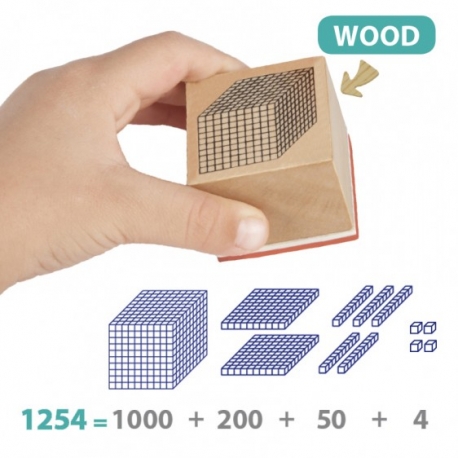
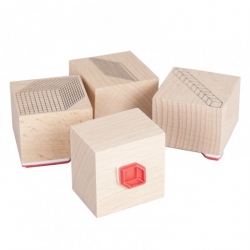
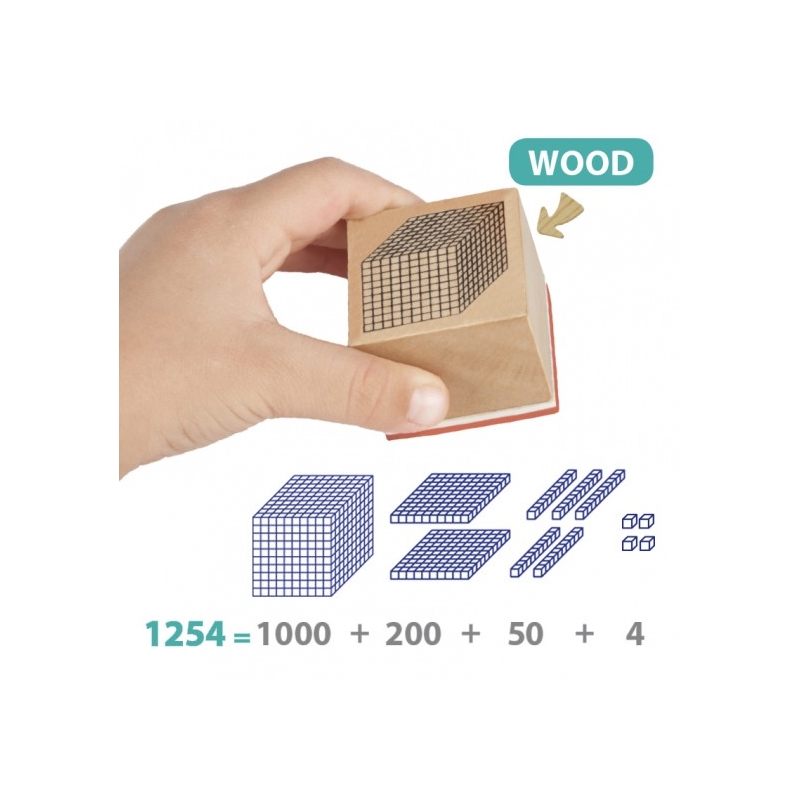
Number decomposition stamps for representing quantities in base 10. A set
of 4 solid wooden stamps representing the unit, the ten, the hundred and the
thousand. Suitable for any ink.
LEARNING OBJECTIVES:
o Establish the link that exists between a given number of objects, their pictorial
representation, their canonical decomposition and their representation with positional
digits.
o Make number decomposition and place value easier for both whole
numbers and decimal numbers.
o Foster the understanding of addition and subtraction operations and their
algorithms.
HOW TO PLAY AND ACTIVITIES:
The following activities are suggested for children aged 3 to 4:
1. Let's represent numbers from 1 to 10
Depending on each child's knowledge, we can write the numbers from 1 to
10 and ask them to represent them with the stamps. So, next to the number one,
the child will stamp the unit, next to the number two, two unit
stamps, and so on progressively up to the number 10 or up to the number the child has
learned. Using the unit stamp is recommended.
2. The friends of….
We write at the top of a sheet the number we
want to work with. As below in a two-column table, we
will place the various sums that give us the number written at the top. For
example, if the top number is 6, ask the children to say who the
friends of 6 are, that is, to say which combinations of numbers give a 6, for
example 1 + 5, 4 + 2, 3 + 3, 4 + 2… They will have to represent them with the stamps.
6
1 5
2 4
3 3
4 2
5 1
6 0
The following exercises will be done once the children have been introduced to
addition and subtraction:
3. Representing single-digit numbers
If we identify the cube as a unit, the number 8 can be represented with 8
cubes, 9 with 9 cubes… and 11 with 11 cubes, but we can group 10
cubes into a rod (since they are equivalent) and we can represent 11
with one rod and one cube. The same can be done with larger
numbers, placing as many block stamps as there are thousand units,
hundreds, or as ten-rods, etc.
4. Exchanges
Note that a block or cube (thousand) is “worth” ten plates (hundreds) and that these
can be grouped or “broken apart” as needed. This applies to
converting plates into rods and rods into cubes and vice versa.
5. Table representation
We divide a sheet of paper into two, three or four columns, one for each
order of magnitude we want to work with: thousand unit, hundred, ten
and units. For each column, we apply the stamp of the corresponding order
of magnitude. Inside, we place the digits of the chosen number. In the example below,
we clearly see that 2364 breaks down into 2 thousand-unit blocks,
3 hundred-plates, 4 ten-rods and 6 unit-cubes. We
can see that a rod is equivalent to ten units, so the 4 written in the column
of tens actually makes 40, or that a block is equivalent to 10 plates, two
thousand units are 20 hundreds, 200 tens or 2,000 units.
Example:
Thousand unit Hundred Ten Unit
2 3 4 6
6. Let's add in a table
A sum is proposed horizontally or dictated and the child is asked to place
the digits in the table and then add them. First without carrying – without
getting more than 9 in each order of magnitude, then afterwards with carrying,
since if there are more than 9 elements in a column, 10 of
them can be exchanged for one of the next higher column.
Example:
Add 1322 + 2531
1322 + 2531
3 8 5 3
7. Simple subtraction.
Subtraction has a different mechanism: it represents the remainder with the stamps
and what is to be taken away.
Example:
Subtraction > 3542-1331
First, in the table represent the upper term with the stamps.
Subtract the subtrahend, in cubes (thousand units), plates (several
hundreds), rods (tens) or cubes (units) accordingly. The digits that
are not crossed out are the result of the subtraction: the remainder, which we will note
at the bottom of each column.
3542 - 1331
2 2 1 1
8. Subtraction with carrying
When we carry out a subtraction, it may happen that we have to subtract
a subtrahend with a value order higher than that of the term to be subtracted.
In this case, you have to go to the higher order and take one element from it and
turn it into 10 of that column.
For example: 3427 – 1274 has more tens in the subtrahend:
3427 - 2274
We see that we do not have enough tens in term 1 (only 2)
to subtract the subtrahend (7). In this case, since we have hundreds, and
one hundred equals 10 tens, we turn one hundred into 10 tens, and
we can then carry out the subtraction.
3427 - 2274
Then we carry out a basic subtraction.
Bankruptcy
A game in which you roll a (six-sided) die nine times, and use the three
smallest stamps. For each dice roll, you choose one of the stamps and stamp
it as many times as needed on a paper to obtain the number rolled on the
die. The aim is to get as close as possible to the number 1000, without
going over.
9. And why not decimals?
Everything seen above is also valid if we consider that one unit can be
represented by any stamp. For example, by the large block. In this case,
the plate (usually “hundreds” and which in any case is the tenth
part of the block) will be the tenth, the rod will be the hundredth and the cube will be the thousandth.
This last activity is recommended when introducing the decimal point in
class.
CONTENTS:
Number decomposition stamps for representing quantities in base 10. A set
of 4 solid wooden stamps representing the unit, the ten, the hundred and the
thousand. Suitable for any ink.