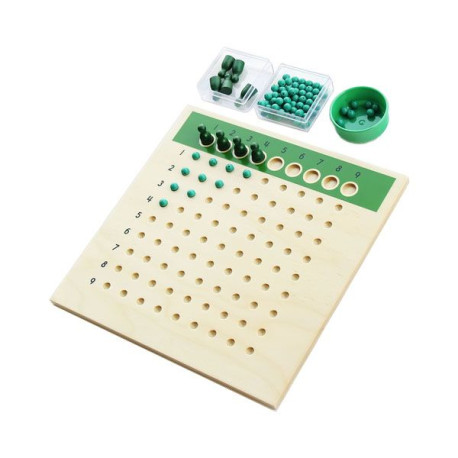
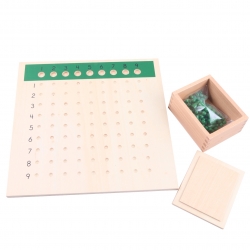
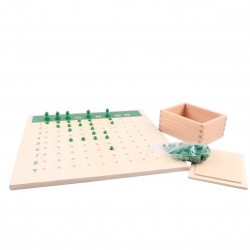
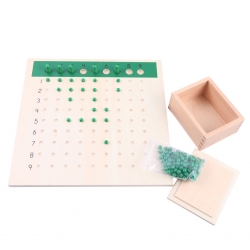
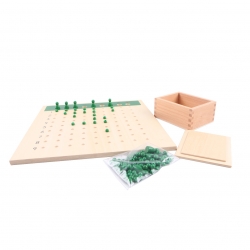
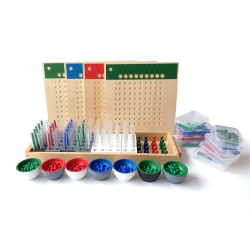
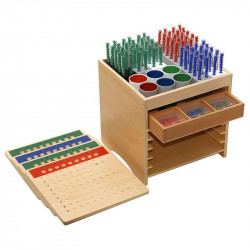
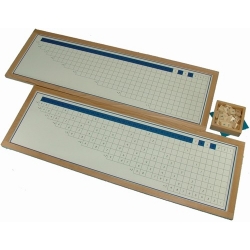
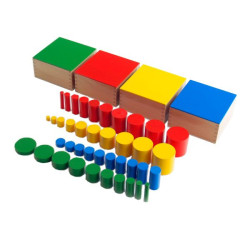
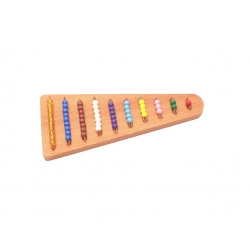
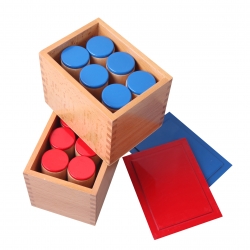
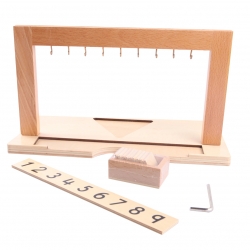
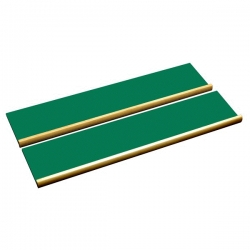
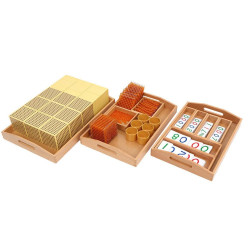
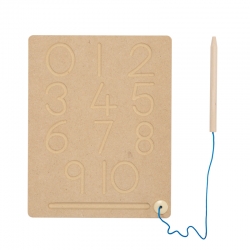
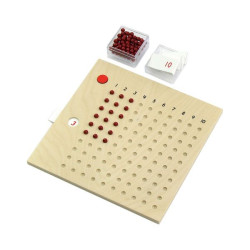
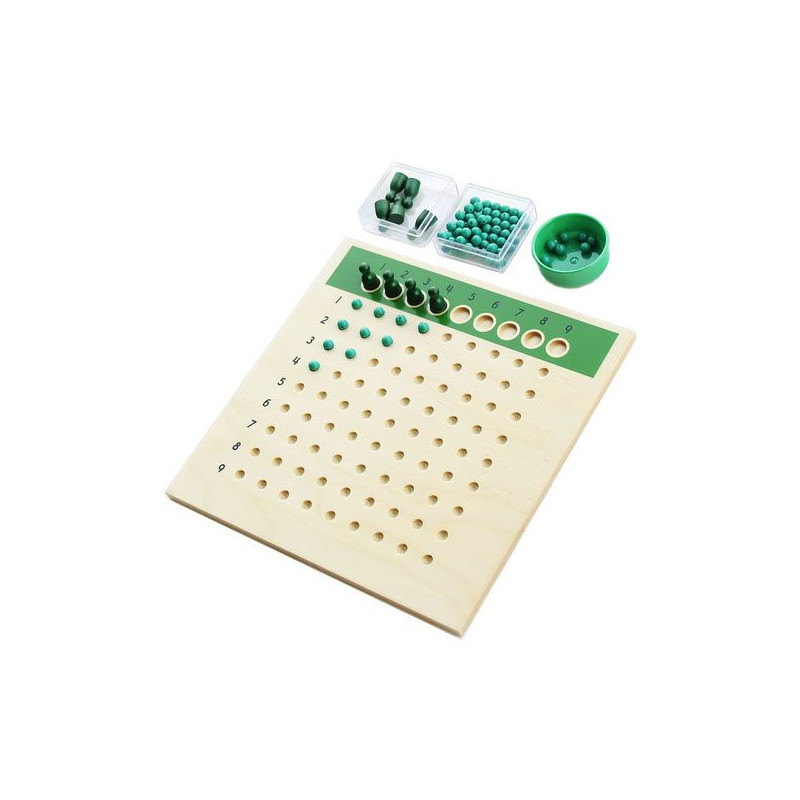
1 wooden board, 9 by 9, with holes: there is the sequence from 1 to 9 at the top of the board with 9 holes representing the divisor; on the left each row is numbered from 1 to 9 and represents the quotient. The 81 holes represent the dividend.
1 tray with a box containing nine skittles
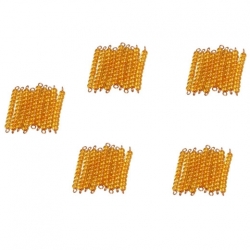
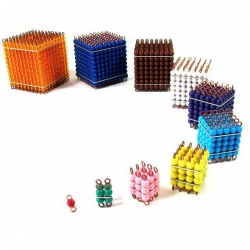
a transparent box of 81 green beads
1 pencil and a red pencil
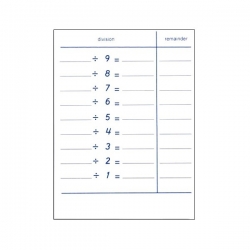
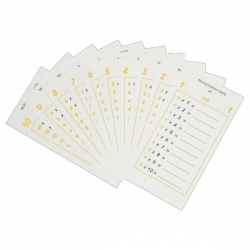
division sheets with four columns (dividend, divisor, quotient and remainder)
Example of a practical exercise:
Fetch the material from the shelf with the child and set it on the table
Sit down at the table with the child and tell him the name of the activity
Tell him you are going to do a division
Open the box of beads and explain that the number we want to divide is 81, that is to say all the beads in the box
Open the box of skittles and tell the child that this is the divisor; we are going to divide by 9, place them in the nine holes at the top
Present the division sheet and have him write the division we want to do: "We said we wanted to divide 81 and the number we want to divide is called a dividend, so we will write 81 in the dividend column, and we want to divide 81 by 9, and 9 is called the divisor, so we will write 9 in the divisor column."
State the first rule of division to him: "The dividend must always be greater than the divisor".
Pour all the green beads into the small bowl
Invite the child to share out the 81 beads by giving one bead to each skittle each time; once he has handed out all the beads, ask him what the result is, read the numbers in the left column, the result is 9
Take the sheet and tell him that the result we have found is called a quotient, so we will write 9 in the "quotient" column
Note that there is nothing left in the bowl, so write 0 in the "remainder" column and underline the operation in red because there is no remainder
Tell the child that we are now going to divide 81 by 8: remove one skittle (it is the divisor that changes) and take away all the beads, put them back in the green bowl
Take the same sheet and invite the child to write 81:8=, 81 in the dividend column and 8 in the divisor column
Invite the child to share out the beads again, this time among the eight skittles
Read the result, 9, and count the number of beads left in the bowl; there are 9 beads left
Write on the division sheet, in the quotient column, the result 9 and in the remainder column 9
At this point tell the child another rule of division: "The remainder must never be greater than or equal to the divisor"; here 9, which is the remainder, is greater than the divisor (8), so we will not keep the combination 81:8=9, remainder 9, and I cross it out on the sheet. There is no point going further (81:7) because it will be even further outside the rule
Take a second sheet and write the operation 80:9=, 80 in the dividend column and 9 in the divisor column
Put the nine skittles back in the holes and remove one bead from the 81 beads in the green bowl (it is the dividend that changes) and put it in the transparent box
Share out the 80 beads equally under each skittle. Only 72 can be shared out and 8 remain in the bowl
Write the result 8 and the remainder 8 in the corresponding columns. The operation follows the rules, so we keep it
Remove one skittle and redo the sharing with 80 beads: 80:8. Only 9 beads can be given to each skittle, so 8 remain. Put the eight beads in the bowl.
Note the result: 80:8=9 and there is a remainder of 8. The remainder equals the divisor, it is not strictly smaller, so I do not keep the combination and I cross out this operation on the sheet
Remove one more bead, leaving 79 beads, and put it in the transparent box.
Invite the child to share out the beads, continuing this way until reaching a quotient of 1, doing this over several sessions, not all on the first day!