keyboard_arrow_left
keyboard_arrow_right

CONTENTS
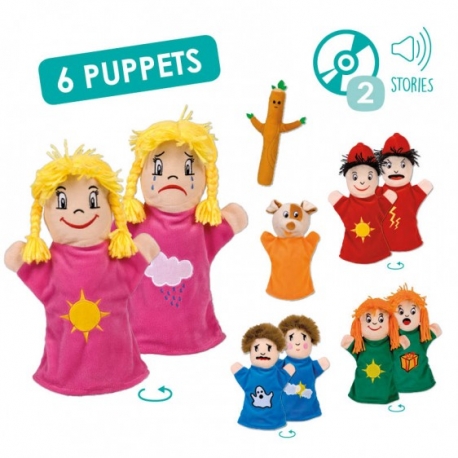
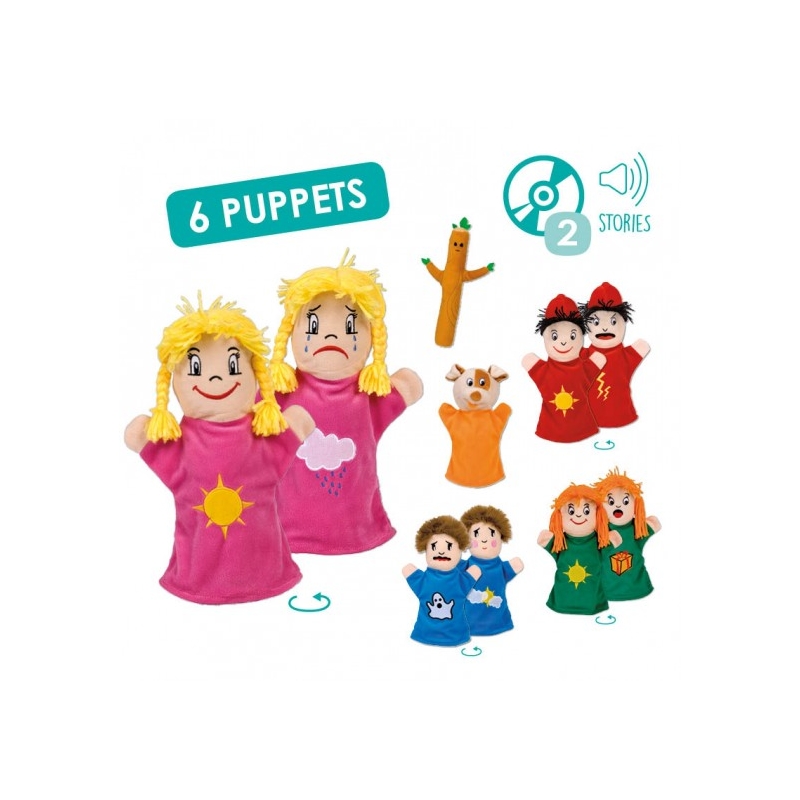
Set of 6 puppets (4 of them reversible with two different faces), supplied with an MP3 AUDIO CD
containing the recording of 2 complete stories with music and dialogue. Acting out the
stories with the puppets allows children to discover “emotions” and makes it easier for them to
recognise them later. Each story lasts about 10 minutes. The CD is available in
several languages to encourage foreign-language learning. The CD lets the teacher
perform the stories without having to narrate them: simply play the AUDIO CD and move the
puppets following the instructions in the booklet. It’s as simple and easy as that!
THEORETICAL INTRODUCTION
The main purpose of this material is to provide teachers with a working tool so that
they can address emotion recognition in the classroom.
We believe it is important for children to know colours, numbers, letters, etc.,
and it seems just as essential to us that they learn the name of what they feel. Putting a name to
something we cannot see but do feel is a complex task; it is even more so
for children, for whom what has no name does not exist.
Knowing how we feel and recognising what others feel is essential for
life in a group.
Among the many existing emotions, we consider the following to be
fundamental: joy, sadness, anger, surprise, fear and shame. Representing each of these
emotions with a graphic symbol makes it easier for young children to
identify them.
EMOTIONS SYMBOL
Joy Sun
Sadness Cloud and raindrops
Anger Lightning
Surprise Gift box
Fear Ghost
Shame Sun and clouds
EN
EXERCISES TO PUT EMOTIONS INTO WORDS
To carry out the suggested activities, cards with the emotion symbols are included at the end of the
booklet. We recommend photocopying and enlarging the images to make them easier to use.
1. Match a symbol to an emotion
a) Show the cards with the emotion symbols one by one, matching them to the corresponding
puppet: the children play at guessing what each one symbolises. Example: match the
“gift box” card with the puppet wearing the same symbol on its costume and
showing a surprised face.
b) Place all the cards with the different symbols face up, ask a pupil to
choose one and call on a classmate to act out the emotion.
2. Match a sentence to an emotion
Level 1
The teacher reads the sentences expressing the corresponding emotion and asks the question below
so the children answer how they think that person feels:
happy, sad, etc.
Level 2
The teacher reads the sentences without expressing any emotion and asks the question below
so the children answer how they think that person feels:
happy, sad, etc.
How does the child feel who says…?
1. “My best friend is coming to sleep over” (joy)
2. “My favourite toy is broken” (sadness)
3. “My brother ate my snack” (anger)
4. “My balloon just popped” (surprise)
5. “A fierce-looking dog is barking” (fear)
6. “My trousers tore and my underwear is showing” (shame)
7. “It’s my birthday” (joy)
8. “The power went out at home, I can’t see anything” (fear)
9. “A girl in my class kissed me” (shame)
10. “The teacher praised me for my work” (joy)
11. “I was opening the drawer of the teacher’s desk and got caught”
(surprise)
12. “My friend won’t talk to me” (sadness).
13. “My pet died” (sadness)
14. “I was invited to a birthday party” (joy)
15. “Someone cut in front of me in the queue” (anger)
16. “I lost my backpack” (fear)
17. “Someone is tickling me” (joy)
18. “They won’t let me go out to play” (sadness)
19. “A friend tripped me up” (anger)
20. “It’s not my birthday and they gave me a present” (surprise)
21. “I was going up the stairs at home on my own and the light went out” (fear)
22. “I slipped on a banana peel in front of my friends and they all laughed” (shame)
3. One character, one question
The teacher shows one of the puppets and gives it a name. The name changes each time
to help the pupils create new stories.
Level 1
The question to ask while showing the puppet is:
“What happened to … (Ben) to make him sad?”
The children invent situations that could have led him to express this emotion.
Level 2
The question to ask while showing the puppet is:
“What happened to … (Ben)?”
The children identify the emotion and invent situations that could have led him to express this
emotion.
EN
Twiggy discovers emotions
Left hand: Right hand:
TWIGGY LEA (PINK costume): happy/sad
NICO (RED costume): angry/happy
BEN (BLUE costume): scared/ashamed
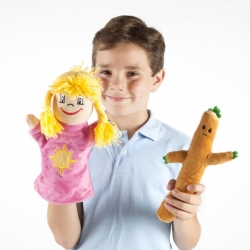
The best way to hold the puppets to use their full range of movement is to
place the thumb in one of the arms, the middle and index fingers at the head and the ring and little
fingers in the other arm. The puppets’ movements allow many
emotions to be expressed. For example:
- with the arms: clapping, waving, stroking, expressing joy and excitement with quick
movements, crying while hiding the face with the arms, etc.
- with the head: speaking, nodding, etc.
- with the body: refusing by swaying the body.
We recommend reading each story in the booklet carefully and listening to the performance of the story
on the MP3 AUDIO CD, then rehearsing the story with the puppets before
staging it.
Set “Lea and Poppy at the funfair”:
The set stays the same throughout the performance. As a backdrop it recreates a funfair
atmosphere, evoking the following images: on the left, a merry-go-round, in the centre a big wheel and on
the right a popcorn stand.
Set “Twiggy discovers emotions”:
The set stays the same throughout the performance. The background evokes a sunny countryside
landscape: a meadow with a few trees, bushes and a country house in the far distance.


CONTENTS
Set of 6 puppets (4 of them reversible with two different faces), supplied with an MP3 AUDIO CD
containing the recording of 2 complete stories with music and dialogue. Acting out the
stories with the puppets allows children to discover “emotions” and makes it easier for them to
recognise them later. Each story lasts about 10 minutes. The CD is available in
several languages to encourage foreign-language learning. The CD lets the teacher
perform the stories without having to narrate them: simply play the AUDIO CD and move the
puppets following the instructions in the booklet. It’s as simple and easy as that!