keyboard_arrow_left
keyboard_arrow_right

CONTENTS:
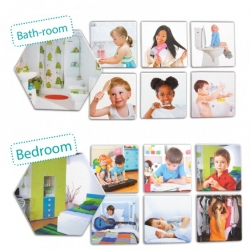
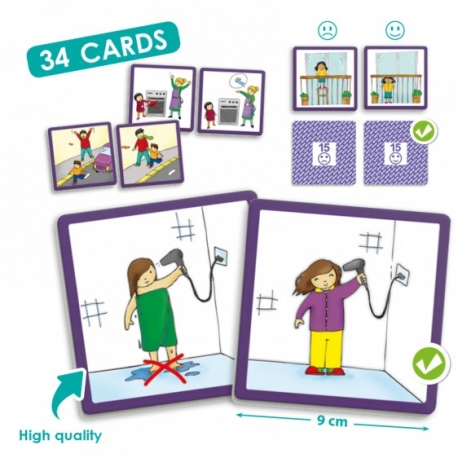
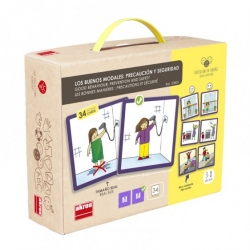
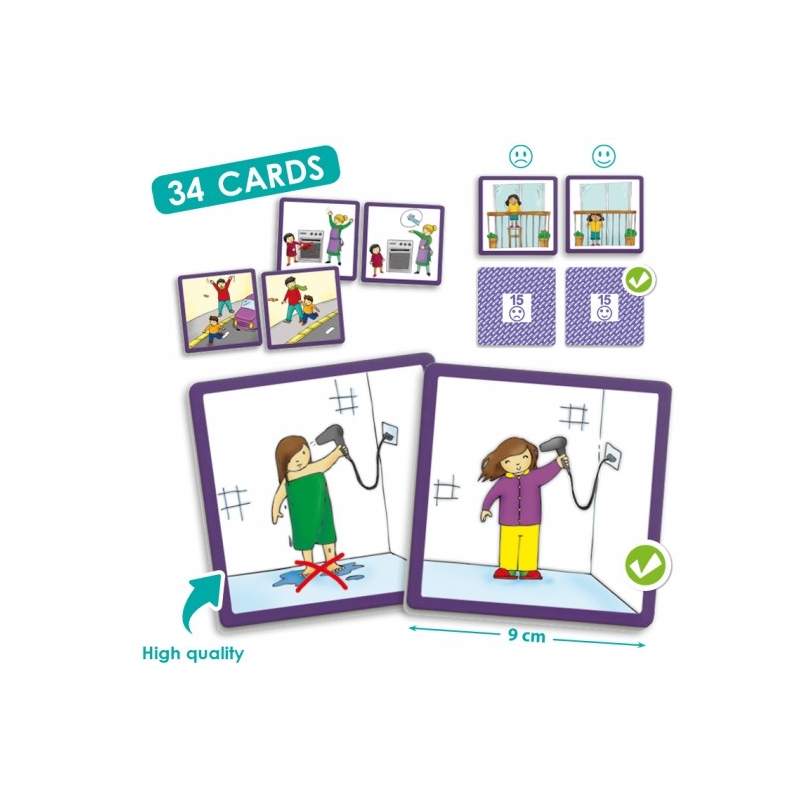
Game including 34 cards measuring 9 x 9 cm.
RECOMMENDED AGE:
From 3 to 8 years.
LEARNING OBJECTIVES:
1. Developing behavioural habits aimed at PREVENTING ACCIDENTS and
promoting CHILDREN'S SAFETY:
· At home:
- Not touching the oven door or the wall sockets.
- Not opening the fridge door barefoot, not drying your hair barefoot
or when the floor is wet.
- Not climbing on the kitchen worktop, not standing on a
stool to lean out of a window or balcony.
- Not approaching or playing with fire.
- Not jumping on the bed.
- Taking the lift with an adult.
· Road safety:
- Wearing the seatbelt.
- Wearing a helmet when riding a bike.
- Using protective gear and a helmet when skating.
- Walking on the pavement next to an adult.
· Community life:
- Not throwing objects on the ground.
- Not throwing objects out of the window or balcony.
2. Developing oral language by expressing the content of the various cards.
3. Learning a second language orally.
HOW TO PLAY AND TIPS FOR USE:
A PAIR-MATCHING game. It involves matching pairs of behaviours
to identify the correct behaviour and the incorrect behaviour within each pair. It
is possible to make 17 matches and to play individually or in small groups.
Once the match is made, the cards forming the pair have a SELF-CORRECTION SYSTEM ON THE BACK
consisting of a shared number and a symbol
identifying the correct behaviour (a happy face) and the incorrect behaviour (a
sad face).
1st It is recommended to explain to the players how the self-correction system
works before using the material.
2nd Match behaviours in pairs and check whether they are
correct by looking at the back (same number).
3rd Select only the cards corresponding to correct habits or
behaviours and check whether it is right by looking at the back (happy
face).
4th Express the correct behaviour out loud.
5th Carry out steps 3 and 4 working with incorrect habits or behaviours
(sad face on the back).
ACTIVITIES:
1. PAIR MATCHING
- After spreading the cards out on the table, various activities are possible:
· Take a card and look for the matching card to form a
pair.
· Take a card showing an incorrect behaviour and look for the
matching card showing a correct behaviour in order to form
a pair.
· Take a card showing a correct behaviour and look for the matching card
showing an incorrect behaviour in order to form a
pair.
2. CLASSIFICATION
- Sort the cards according to the behaviours, namely whether they are correct or incorrect.
3. ORAL EXPRESSION
- With the cards corresponding to incorrect behaviours, the player must
explain their content by expressing them in negative terms. E.g.: “do not throw
paper on the floor”.
- With the cards corresponding to correct behaviours, the player must
explain their content using positive language. E.g.: “you should throw paper in
the bin”.

CONTENTS:
Game including 34 cards measuring 9 x 9 cm.
RECOMMENDED AGE:
From 3 to 8 years.