- Out-of-Stock
keyboard_arrow_left
keyboard_arrow_right

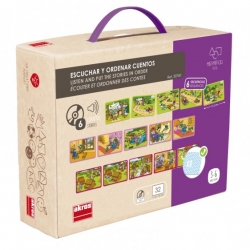
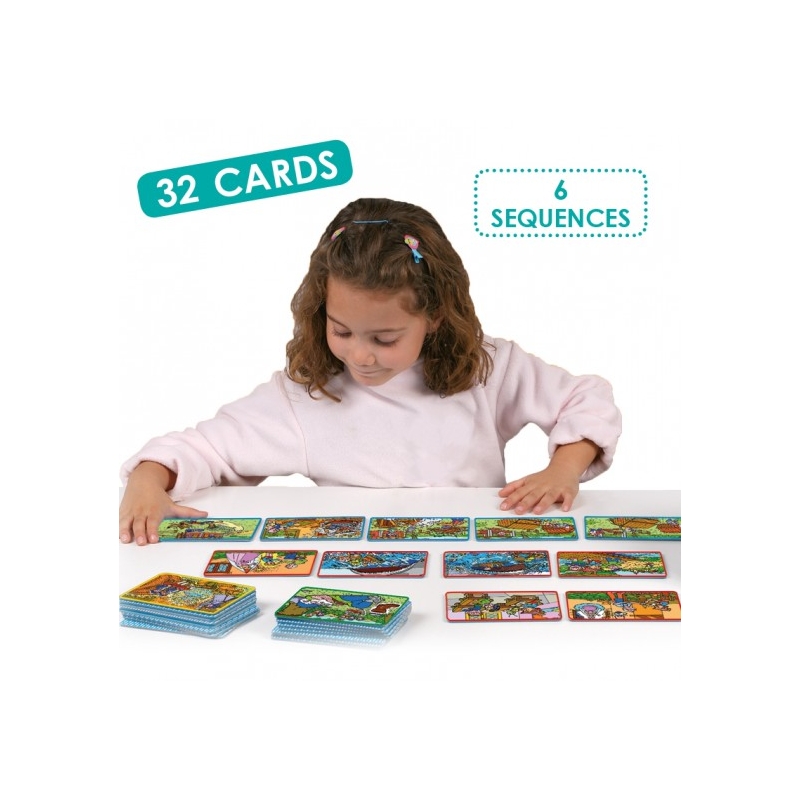
LISTEN TO THE TALES AND PUT THE CORRESPONDING SEQUENCES IN ORDER.
CONTENTS
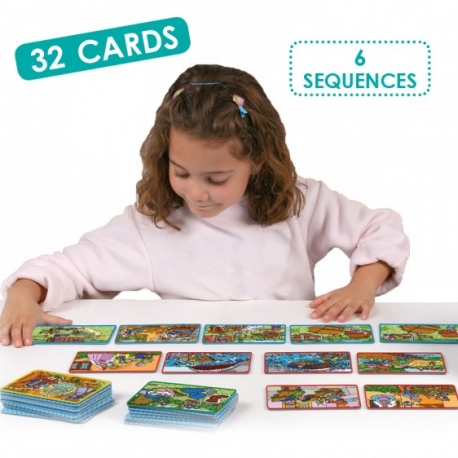
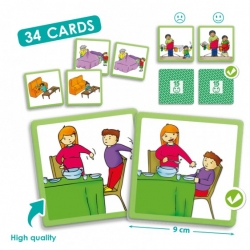
- 32 CARDS of 11.2 x 7.8 cm. for sequencing the 6 tales.
PSYCHO-EDUCATIONAL OBJECTIVES
A SEQUENCING GAME that fosters the development of many aspects of children's
psychological development:
- Acquiring the notion of time.
- Developing the logical temporal sequence by putting the different
scenes in order.
- Learning notions of time (before, then, after, etc.).
- Developing listening skills.
- Stimulating and enriching language: it stimulates the child's oral expression while
allowing them to structure their language. It enables the acquisition of vocabulary words and
the assimilation of complex linguistic structures.
- Facilitates the learning of other languages.
RECOMMENDED AGE
From 3 years.
DESCRIPTION
- A different color is assigned to each TALE to make sorting easier:
* THE THREE LITTLE PIGS…… : 5 blue cards.
* HOP-O'-MY-THUMB…………………... : 5 pink cards.
* THE HARE AND THE TORTOISE ………. : 5 lilac cards.
* PUSS IN BOOTS……………... : 5 green cards.
* CINDERELLA………….…………. : 6 yellow cards.
* PINOCCHIO………………………….. : 6 red cards.
SELF-CORRECTION SYSTEM ON THE BACK OF THE CARDS: a numbering corresponding to
each tale (from 1 to 5 or 6), according to its narrative order.
INSTRUCTIONS AND RECOMMENDATIONS
The child must first listen to the recording before putting the cards into sequence
order. On a second listening, they can place the cards in the chronological order
of the tale. At the end of reading the tale, they can look at the back of the cards to check whether
they are correctly ordered. Finally, they should be able to tell the tale and
put the cards in order without resorting to the recording.
HOW THE ACTIVITIES UNFOLD
1. Listen carefully to the tale before putting the cards in chronological order.
2. The child will choose, among all the cards, the one that matches the sequence of
the recording. At the end of the story, they will turn the cards over to check whether they are in
numbering order from 1 to 5 (or 6).
3. When the child knows the tale, they can put the cards in order without having to listen to
the recording.
4. From the cards they have put in order, the child can tell the tale themselves.
5. They can also put the cards in order while telling the tale themselves.
“The Three Little Pigs”
Three little pigs, who were three brothers, lived in a thick forest. The wolf
was always lying in wait to catch them.
To escape the wolf, they each decided to build themselves a house. The smallest built his out of
straw to finish quicker and go off to play. The middle one built a wooden house. Seeing
that his little brother had finished and gone to play, he hurried to finish too and went to play with
him.
As for the eldest, the most responsible of the three brothers, he built a solid brick house with great effort. –“You'll see, when the wolf comes, how long your houses will last,” he reproached
his brothers who were playing in the forest.
Suddenly the wolf appeared and the little pigs ran to hide in their houses. The wolf
first attacked the smallest one's house. He huffed and puffed and the straw house collapsed.
Chased by the wolf, the little pig ran to take refuge with the middle brother. But the wolf huffed and
puffed and the wooden house collapsed.
The two little pigs fled, the wolf at their heels, and they managed to get, out
of breath, into the eldest's house. Once inside, they carefully closed all
the doors and windows.
The wolf circled the house several times, looking for a way to get in. With a
large ladder, he climbed onto the roof and slid down the chimney. But the eldest of the
little pigs, who was clever, had put a pot of water on the fire.
The big bad wolf fell into the boiling water and burned himself. He fled, howling in
pain.
They say that ever since, the three little pigs have never heard of him again.
“Hop-o'-My-Thumb”
Hop-o'-My-Thumb was the youngest of seven brothers. His parents were very, very poor. They
realized they could no longer feed their children, but they did not want to see them
die of hunger. With heavy hearts, they decided to take them into the forest and
abandon them to their fate. But Hop-o'-My-Thumb, who was clever, understood their intentions. That morning,
their mother gave each of them a piece of bread. Hop-o'-My-Thumb, instead of eating his, made
crumbs of it that he dropped one after another on the ground to mark the path. When the seven
children found themselves all alone, lost in the middle of the forest, Hop-o'-My-Thumb told them not
to worry, that he would be able to find the way back by following the breadcrumbs. But
the birds had eaten them all. Walking at random, they found a little
house where they decided to knock to ask for lodging for the night. The woman who
opened the door for them had as a husband a wicked ogre who ate children. Seeing those seven
little ones, she did not have the heart to leave them outside. She let them in, telling them they
should hide in the cellar when her husband came home. The ogre arrived, demanding his
dinner, and immediately smelled the scent of fresh flesh. He soon discovered the seven children in
their hiding place. Fortunately, his wife persuaded him to wait until the next day to eat them
because she had prepared a delicious meat stew for him. Hop-o'-My-Thumb and his brothers took advantage
to escape through a window the woman had left open. But when the ogre
noticed their flight, he put on his magic seven-league boots and set off in
pursuit. Tired of searching the forest, he lay down to rest and fell asleep right near
the place where the seven brothers had hidden. Hop-o'-My-Thumb, who was very brave, removed his
seven-league boots and put them on his own feet. The magic boots immediately took his size
and with these boots Hop-o'-My-Thumb could cross the forest at full speed, find his house, come back
for his brothers and save them from the wicked ogre. With the seven-league boots, he could
run faster than the wind and the king made him his personal messenger.
And so Hop-o'-My-Thumb and his family never had to suffer from hunger again.
”The Hare and the Tortoise”
Once upon a time there was a pretty forest where a hare, a tortoise and other
animals lived. Everyone knew that the hare was nimble and fast, but proud. And also that the
tortoise was slow, but patient and persevering. One day a race was organized in which the
hare lined up, of course, but also the tortoise.
-“Tortoise, do you really want to run this race? You know perfectly well that I'm going to beat you,” the hare
mocked, full of pride and sure of himself.
The start was given. The tortoise set off slowly, one small step and then another, while the
hare took the lead in two strides. Turning around, the hare saw the tortoise far behind
him. So he thought he could well stop to drink. The patient tortoise continued on its
way, one small step and then another. After drinking, the hare saw that the tortoise, despite its
slowness, had advanced well and had almost caught up with him. He started running again and gained over the tortoise
a considerable lead. Seeing it so far away, he decided to stop and rest in the shade
of a tree. While the tortoise continued on its way, slowly but without stopping either to
drink or to rest, the hare fell into a deep sleep. And when he woke up, however much he
ran, the tortoise was so near the finish that it won the race.
That is how the steady and patient tortoise that day beat the fast and
proud hare.
“Puss in Boots”
Once upon a time there was a miller who, when he died, left his mill as an inheritance to his
eldest son, a donkey to the middle one and, to the youngest, a cat. But that cat was no ordinary
cat. To help his master, he asked him for a bag and a pair of boots and set off
hunting.
He killed two partridges, put them in the bag and went to bring them to the king. -“Sire, the Marquis of
Carabas my master begs you to accept this modest gift.”
One day when the king was out walking with his daughter, the cat asked his master to bathe in the
river. Then he hid his clothes and, when the king's carriage came by, he began to shout:
“Help! The Marquis of Carabas my master is drowning.” He recounted that bandits had
stolen his master's clothes and thrown him into the river. The king had him dressed in
a marquis's costume and the princess, seeing him so handsome, fell in love with him. The king offered
the young man to take him back to his castle in the royal carriage.
The cat went ahead and persuaded the peasants he met to tell the king that the
fields they were reaping belonged to the Marquis of Carabas. And that is what they did
when the king's carriage came by.
The cat arrived at the castle of the true master of these lands, a wicked man who had the
power to transform himself into any animal. The cat begged him to turn into a lion
and the man transformed into a ferocious lion. -“That's easy,” mocked the cat, “but you surely don't
know how to turn into a smaller animal, a mouse for example.” The man
turned into a mouse. The cat pounced on him and swallowed him.
At that moment, the king's carriage was arriving. The cat welcomed him to the castle of the
Marquis of Carabas. The king marveled at the sight of this castle and thought the marquis would make
a good husband for his daughter.
And so it was that, thanks to the ingenuity of Puss in Boots, the miller's son, having become Marquis of
Carabas, married the king's daughter.
“Cinderella”
Once upon a time there was a young and beautiful orphan named Cinderella. She lived with
her stepmother and her two stepsisters, who were jealous of her beauty and made her work without
cease.
One day, they were invited to a ball given at the palace by the prince, but Cinderella was not allowed
to go, because she had to wash the floor and prepare the supper for their return.
Left alone, Cinderella began to cry and lament her sad fate.
Then her fairy godmother appeared and said to her:
-Cinderella, you have a good heart, you deserve to go to the party.
And with a wave of her hand, the fairy transformed her poor clothes into a magnificent dress. She
transformed a pumpkin into a carriage, four mice into horses and four lizards into coachmen.
And she said to Cinderella:
-Don't forget one thing, you must be back before midnight, for then everything will become as
before.
Cinderella set off for the ball that very instant.
Throughout the party, the prince looked only at her and they danced together all evening. The
guests wondered who this beautiful young woman was, and even her stepsisters could not
recognize her. Cinderella was so happy that she remembered the fairy's warning only at
the moment she heard the first stroke of midnight. She left the palace so hastily that she
lost one of her glass slippers.
As this slipper was the only thing left of her, the prince announced that he would marry the
young woman to whom it belonged.
He traveled the kingdom, trying it on the foot of every lady, but none had a foot as
dainty as Cinderella's.
When Cinderella's turn came, the slipper, to everyone's surprise, fit her perfectly.
Then the prince and Cinderella promised never to part again, they married and were very
happy.
“Pinocchio”
Once upon a time there was a very kind old man named Geppetto. He was very skilled
at making wooden puppets. One of these puppets seemed to him so well made that he wanted
to give it a name. “He will be called Pinocchio,” he said to himself. “What a pity he is not a real
little boy, he would be like a son to me,” dreamed the good man who had never had
children.
That night, while Geppetto slept, the Blue Fairy came to his workshop. She found
Pinocchio so beautiful that she wanted to reward the artist by giving life to his puppet. The next
morning, what joy Geppetto felt when he saw that Pinocchio moved, walked, laughed and
spoke. Yet he had remained a wooden puppet.
Geppetto wanted to give Pinocchio an education and sent him to school. There Pinocchio made
the acquaintance of the kind Talking Cricket, who became his best friend.
But he also befriended two bad rascals and, instead of going to school and following the good
advice of the Talking Cricket, he went with them to have fun and get up to mischief. The Talking Cricket was
quite sad about it. Then Pinocchio stopped going to school altogether and set off on an adventure.
Soon, since he could neither read nor write, he grew big donkey ears and, on top of
that, every time he told a lie, his nose grew longer and turned all red.
One day, the Talking Cricket learned that Geppetto had gone in search of his dear Pinocchio
in a little sailing boat and that an enormous whale had swallowed him. The Talking Cricket and
Pinocchio in turn set out to sea to come to his rescue.
When the whale saw them in front of it, it opened its enormous mouth and swallowed them whole,
as it had done with Geppetto. So at last Geppetto and Pinocchio were once again
reunited. But they had to think of a way to get out of the whale's belly. “I've got it,” said the
Talking Cricket, “let's make a big fire.” The fire made the whale sneeze, and it immediately spat out the
boat and its three occupants.
Pinocchio returned to Geppetto's home, went to school every day and behaved like a very good little boy.
Geppetto was proud of him and the Blue Fairy, to reward him, transformed him into a real
little boy of flesh and bone.



LISTEN TO THE TALES AND PUT THE CORRESPONDING SEQUENCES IN ORDER.
CONTENTS
- 32 CARDS of 11.2 x 7.8 cm. for sequencing the 6 tales.