Cookie consent management

Auditory Sense

The Sense of Hearing: The Art of Listening to Silence and Sound

At Montessori Store, we view hearing as a sense that is both universal and intimate, a window opening onto the invisible world of vibrations. Our collection of Montessori auditory materials introduces the child to conscious listening, where every sound becomes a message, every silence a space for concentration, and every vibration a lesson in natural physics.

Hearing: The First Sense of Communication and Order

Maria Montessori placed auditory education at the heart of her pedagogy, recognising that the ability to listen precedes and prepares the ability to communicate, to concentrate and to bring order to one's thinking. Our materials transform the sonic environment into a natural classroom.

The 4 Dimensions of Montessori Auditory Development

1. Sound discrimination

  • Pitch, intensity, timbre
  • Natural sounds vs produced sounds
  • Associating sound with its source

2. Sensorial music education

  • Relative pitches (low/high)
  • Musical intervals
  • Rhythms and pulses

3. Cultivating silence

  • Listening to the environment
  • Perceiving distant sounds
  • Appreciating quiet

4. Spatial localisation

  • Direction a sound comes from
  • Sound distance
  • Acoustic environments

Our Selection of Montessori Auditory Materials

For basic sound discrimination

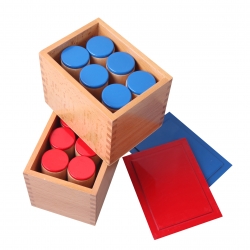
  • Sound boxes: 6 pairs of identical cylinders - matching by ear alone
  • Montessori bells: 13 tuned bells for sensorial music education
  • Sound bottles: different materials, same quantities - identifying timbres
  • The silence game: developing fine listening and concentration

For progressive music education

  • Sound lotto: matching image to sound
  • Sensorial music notation cards: raised notes
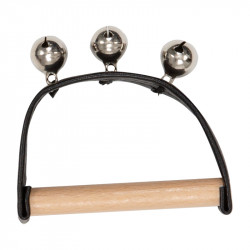
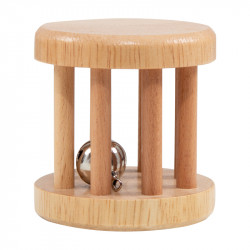
  • Simple instruments: triangle, tambourine, child-friendly maracas
  • Acoustic exploration set: strings, membranes, sound tubes

Combined auditory-visual materials

  • Sound nomenclature cards: image + recording or instrument
  • Sound sequence games: reproducing rhythms
  • Auditory memory: matching identical pairs by ear

For the scientific exploration of sound

  • String telephone: understanding vibration and transmission
  • Child-friendly tuning forks: experimenting with frequencies
  • Musical tubes: different lengths, different notes
  • Simple recording set: capturing and recognising one's own voice

The Benefits of Montessori Auditory Materials

Deep concentration: listening calls for complete attention
Auditory memory: developing fine discrimination
Natural music education: sensitivity to pitch and rhythm
Improved communication: active listening and understanding
Inner calm: the ability to appreciate silence

Technical Features of Our Materials

Optimal acoustic quality:

  • Pure, non-electronic sounds
  • Materials carefully chosen for their sound quality
  • Precise tuning for the musical instruments
  • Isolation of sound variables (one parameter at a time)

Safety and durability:

  • No dangerous small parts
  • Sturdy construction for repeated handling
  • Non-toxic finishes
  • Easy to maintain

Educational progression:

  • Strong contrast first, then subtle nuances
  • Isolating one sound quality at a time
  • Self-correction by ear
  • A connection to the everyday environment

Usage Guide by Age

2-3 years: Present 2 strongly contrasting sounds (loud/soft)
3-4 years: Introduce identical pairs and familiar sounds
4-5 years: Offer graded series and recognition games
5-6 years: Explore complex sequences and music education

Expert tip: "Present auditory activities in a calm space, away from background noise. Teach the child to close their eyes to focus attention more fully on the sense of hearing."


Open your child's ears to the symphony of the world.
Explore our unique collection of Montessori auditory materials and cultivate the precious art of conscious, musical and scientific listening.

To listen is already to understand.